
- Early Years, journey 1
- Junior, journey 2
- Maker, journey 3
- Explorer
- Creator, journey 5
- Researcher, journey 6
Look inside the network, and change how it learns.
Explorer is planned. It will take learners inside neural networks: what each layer finds, how training settings change the result, and how to judge a model by more than one number. Parts of it already run inside Maker.
- Who it is for
- Learners who have trained models in Junior or Maker and want to know what happens inside.
- What learners will build
- Models they change and compare: studied longer or shorter, with more or fewer layers.
- What you need first
- Experience training a model, and being comfortable reading a simple chart.
- Available now?
- No. Explorer is planned, with no launch date. Parts run inside Maker now.
For learners who want to know how it works
Junior and Maker keep a model’s settings out of the way. Explorer is where learners change them on purpose and measure what happens.
What makes this stage different
Earlier journeys ask “does it work?”. Explorer asks “why does it work, and what would make it work better?”. The answers come from experiments: change one setting, train again, compare.
Planned The aims below are for the Explorer journey. The next section shows what already runs inside Maker.
Explains layers
Says what the early and later layers of a picture network find, from what the X-Ray shows.
Changes one setting at a time
Runs fair experiments with training settings and compares the results.
Spots memorising
Recognises when a model has memorised its examples instead of learning from them.
Judges by more than one number
Reads a mix-up table and a learning curve, not only the score.
What already runs inside Maker
These are real screens from Maker, which is open now. Explorer will build its lessons around them.
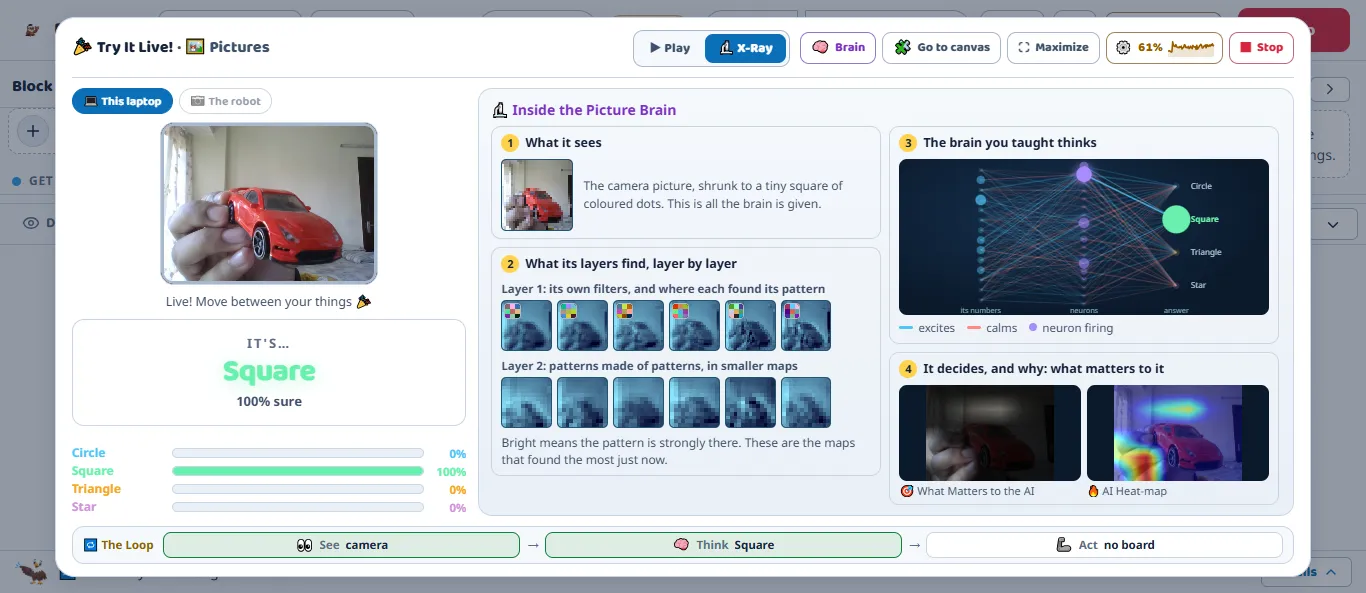
Each layer, from the running model
The Picture Brain’s X-Ray shows its own learned filters and the maps each layer makes for the camera picture right now. Bright means the pattern is strongly there.
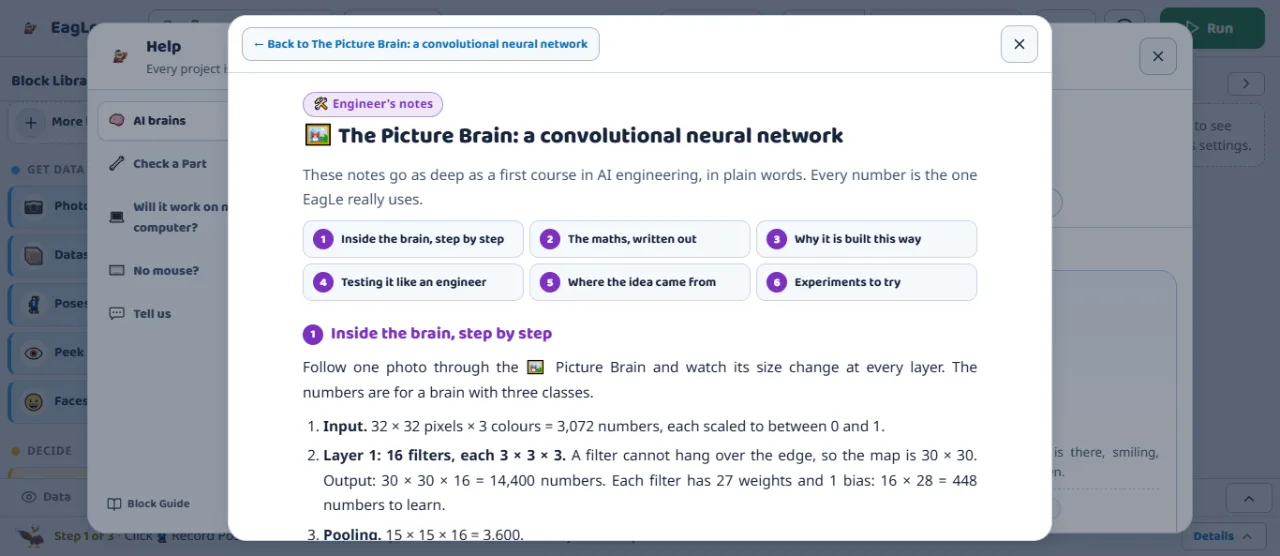
The maths, written out
Every AI chapter in Maker has a deeper level: the brain step by step, the maths, why it is built that way, how to test it, where the idea came from, and experiments to try.
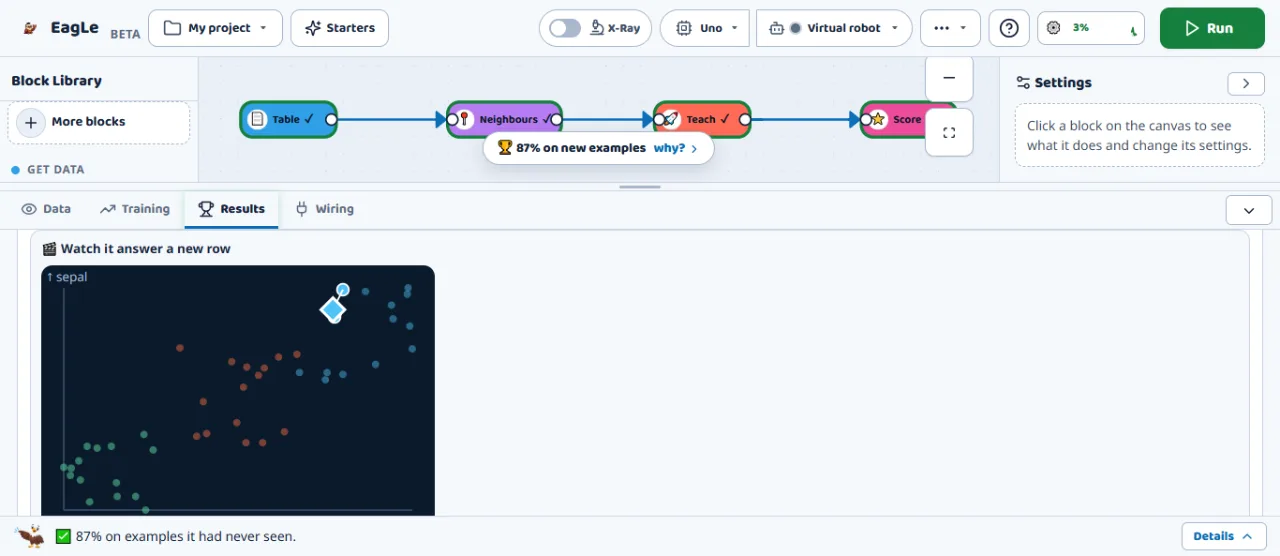
Not every model is a network
Maker also has a decision tree you can read question by question, nearest neighbours, a straight-line predictor and clustering. Comparing them is part of understanding networks.
One experiment at a time
The planned shape of every Explorer lesson.
Planned
Ask
Pick one question: does studying longer help?
Change one thing
Change a single setting and keep everything else the same.
Train and measure
Train again and record both scores and the learning curve.
Explain
Use the X-Ray and the mix-up table to say why it changed.
In Maker today: how many times should it study?
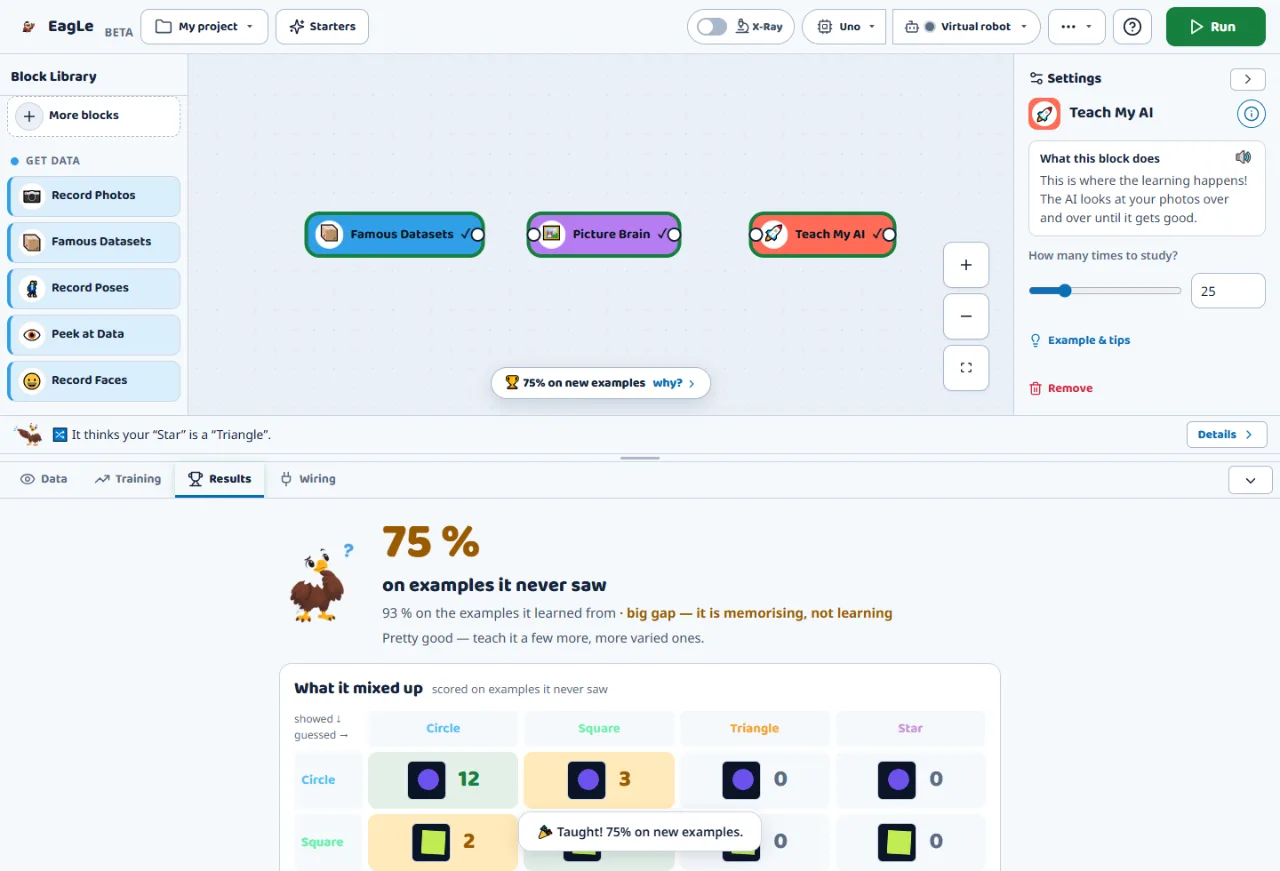
A real experiment learners can run today. Teach My AI has one training setting, how many times to study, from 5 to 100.
- What the learner builds
- A shape classifier from a famous dataset, trained several times with a different setting each time.
- What changes
- Only “How many times to study?”. The data and the brain stay the same.
- What they must understand
- Studying longer can raise the score on studied examples while the score on new ones stops rising: memorising.
- How it is measured
- The score on held-back examples, the score on studied ones, and the gap between them.
Ideas Explorer is designed to teach
Layers build on layers
Early layers find edges and colours; later layers combine them into shapes and parts.
Weights are what is learned
Training adjusts thousands of numbers. The X-Ray shows which ones push the answer.
More training is not always better
Past a point, a model memorises its examples and does worse on new ones.
Settings are trade-offs
Bigger or longer is slower and not always more accurate.
A score hides detail
The mix-up table shows which classes fail, which one number cannot.
Fair tests change one thing
Change two settings at once and you cannot tell which one mattered.
Measure, compare, explain
Evaluation in Maker already reports both scores, the gap between them, and what the model mixed up.
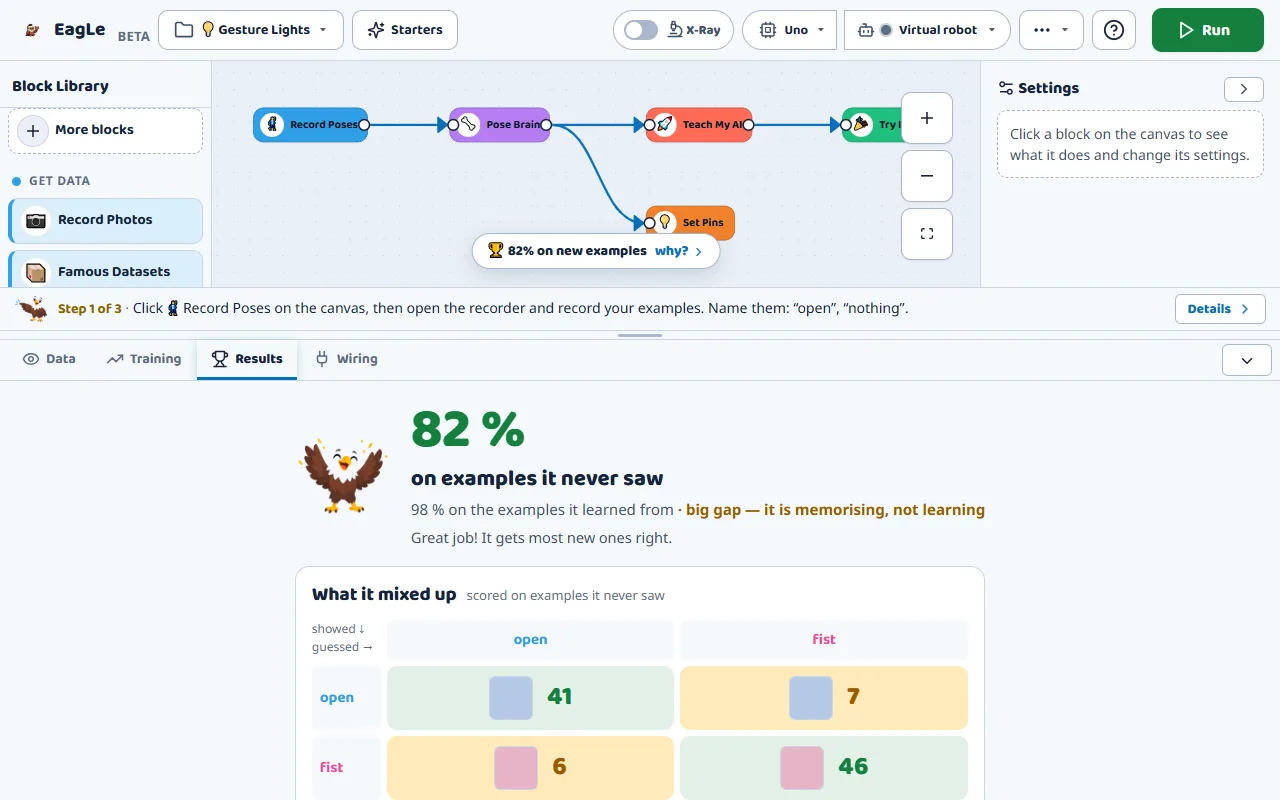
Hold back the test examples
Maker holds back part of every class; for tables, how much is a setting (up to half).
Compare runs
Write down both scores for each run, then compare the gaps.
Read the mix-up table
Find the pair of classes it confuses, and look at those examples.
Planned for Explorer Changing learning speed and the number of layers, and placing two learning curves side by side.
How real teams work
Picture networks everywhere
Photo search and medical imaging use convolutional networks: the same kind as the Picture Brain, much larger.
Held-back test data
Every serious AI team keeps examples aside that the model never sees until the final test.
Experiments, not guesses
Engineers change one setting, measure, and keep a record, exactly as Explorer will ask.
Where Explorer sits on the path
Explorer follows Maker. It needs a learner who has trained models and wants to understand them.
For teachers and parents
What you can use today, and what Explorer will add.
- Today, inside Maker
- The X-Ray of every brain, Engineer’s notes for every AI chapter, both scores and the mix-up table, and the study setting.
- Planned for Explorer
- Lessons built around experiments, more training settings, and side-by-side comparisons.
If you teach older learners who have finished Maker projects, Maker’s Engineer’s notes already go as deep as a first course in AI engineering, in plain words. See Maker.
Planned, with no launch date yet
Leave your email and we will write once, when Explorer opens. Until then, Maker has much of it.
Get told when Explorer opens
Start inside Maker now
Maker is open and free during early access. Its X-Rays, Engineer’s notes and score cards are where Explorer’s ideas begin.
Questions about Explorer
When will Explorer open?
Can learners do any of this now?
Will it let learners change the learning rate or the layers?
What should a learner do first?
Curious about what is inside?
Explorer is planned. Maker is open now, and every brain in it has an X-Ray.