- Early Years, journey 1
- Junior, journey 2
- Maker, journey 3
- Explorer, journey 4
- Creator
- Researcher, journey 6
How a computer reads, and how it writes.
Creator is planned. It will focus on language AI: turning words into numbers, sorting sentences by meaning, writing one word at a time, and building chatbots. Three language brains already run inside Maker.
- Who it is for
- Learners who read and type sentences comfortably and want to know how chatbots work.
- What learners build
- In Maker today: a chatbot that answers out loud, a story writer, and a map of word meaning.
- What you need first
- Typing sentences. Junior or Maker helps, but is not required.
- Available now?
- No. Creator is planned. Its three language brains run inside Maker now.
For learners curious about words and chatbots
Pictures and sounds come first in Junior. Creator is where the data is language, the kind of AI most people now meet every day.
What makes this stage different
Language looks like meaning, but a computer only sees numbers. Creator shows exactly how sentences become numbers, how a model picks an answer or a next word, and why a fluent answer can still be wrong.
Planned The aims below are for the Creator journey. The next section shows the language brains already inside Maker.
Turns words into numbers
Explains two or more ways a computer represents a sentence, and what each one loses.
Builds a language model
Teaches a sentence sorter and a next-word writer from their own text.
Tests on new sentences
Checks a model with sentences it never saw, and finds which words decided.
Separates fluent from true
Explains why a model that writes well can still be wrong.
The language brains inside Maker
Real screens from Maker, which is open now.
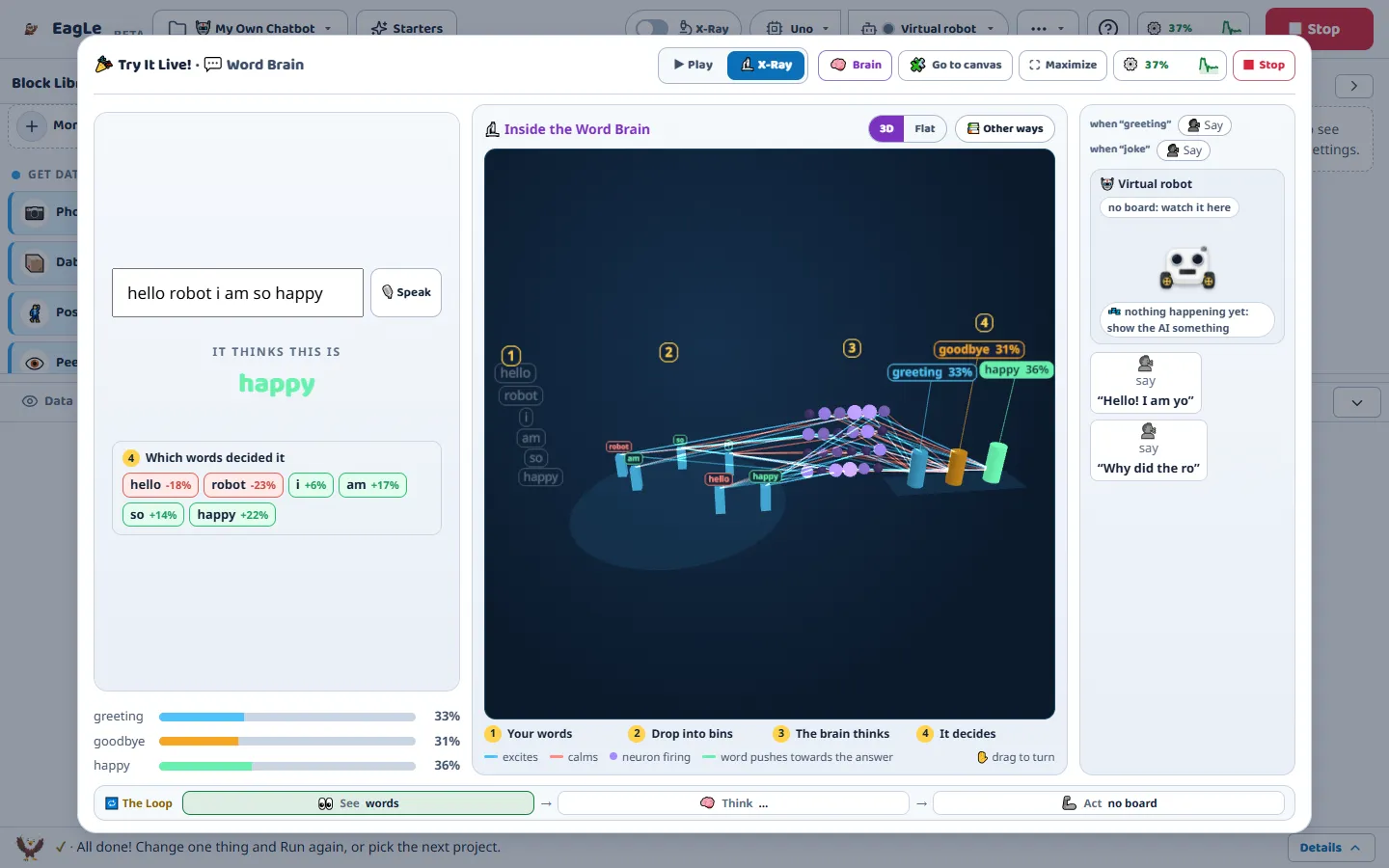
Sorts sentences into ideas
A bag-of-words classifier the learner teaches with their own sentences. Its X-Ray shows each word’s push on the answer.
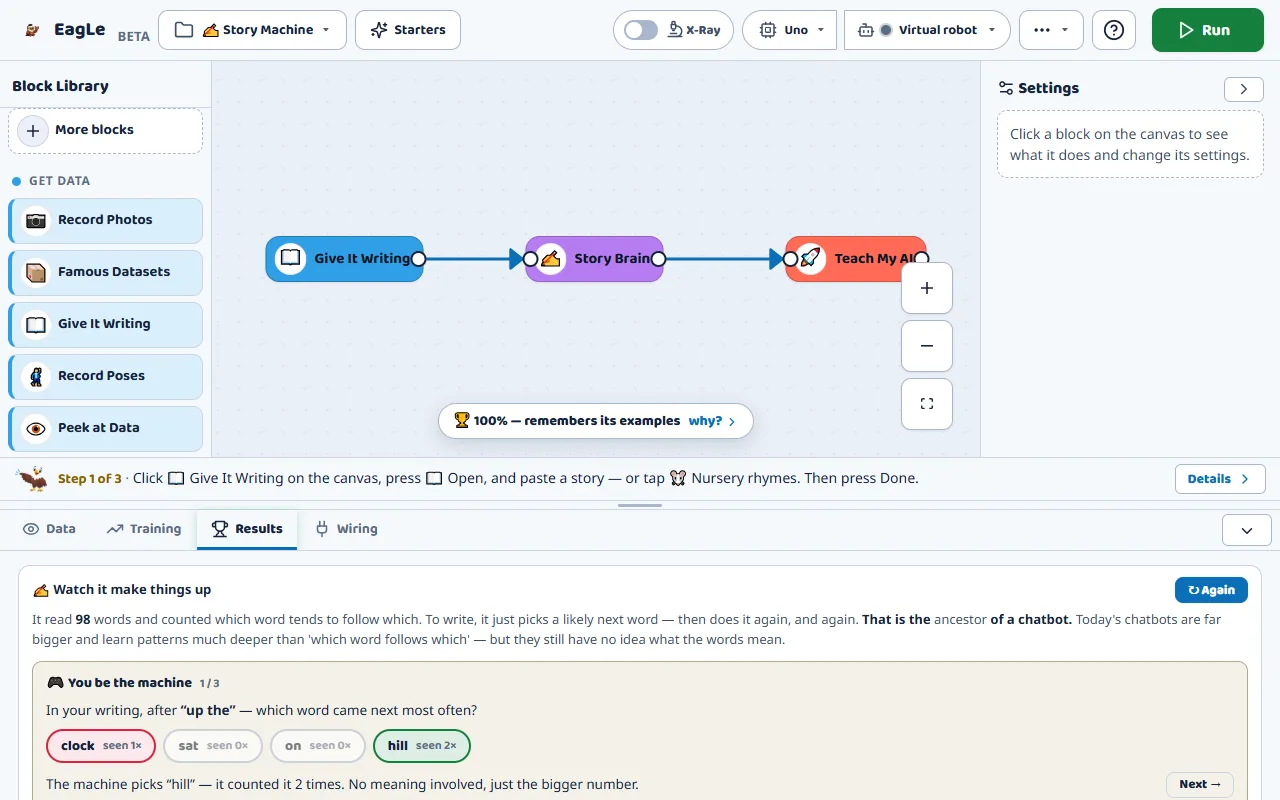
Writes one word at a time
A next-word model built by counting which word follows which in the learner’s writing. The app says plainly: no meaning involved, just the bigger number.
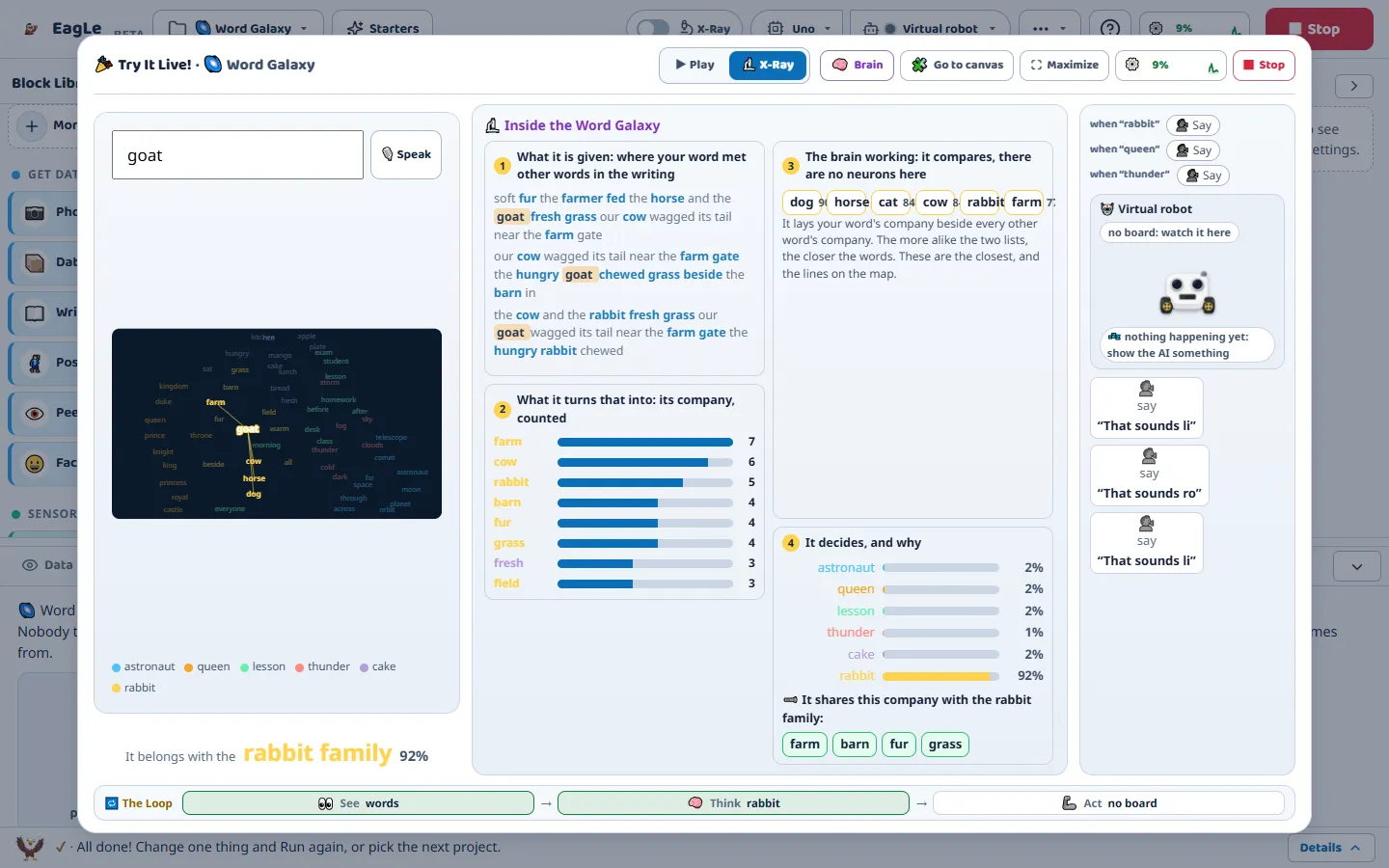
Meaning from the company words keep
A map where words used in similar places drift together. A typed word joins a family, and the robot can answer by family.
Input, processing, output, evaluation
Every language model in Creator will be explained in these four parts. The Maker brains already follow them.
Input
Sentences the learner types, or writing they paste in.
Processing
Words become numbers: counted in a bag, counted by which word follows, or placed by the company they keep.
Output
An idea and how sure it is, a next word, or a word family.
Evaluation
New sentences it never saw, and which words decided each answer.
In Maker today: My Own Chatbot
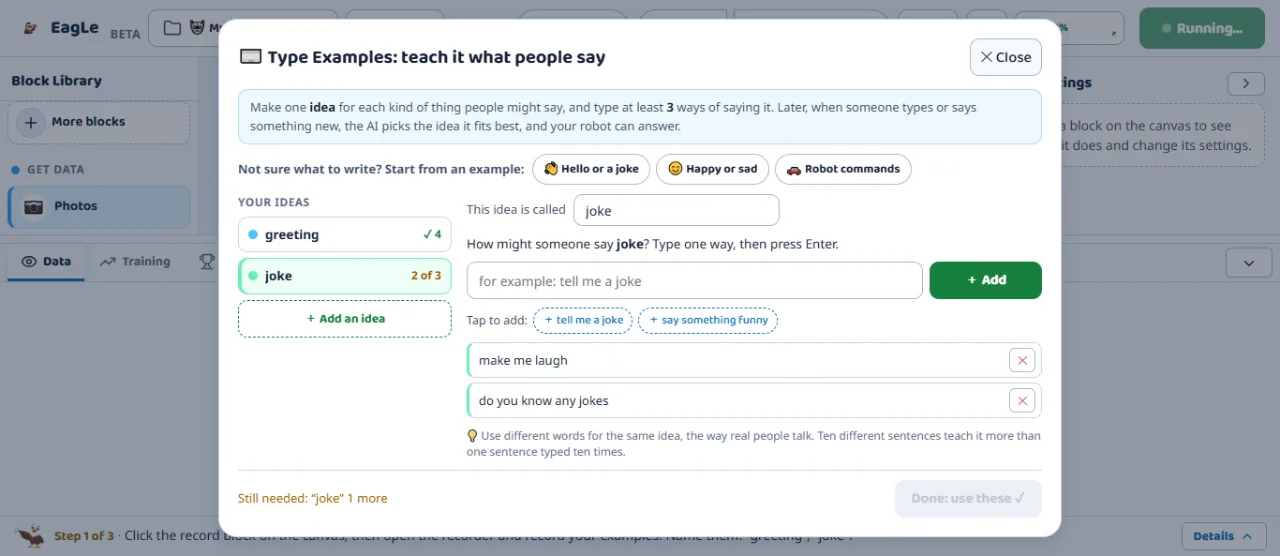
One of Maker’s starter projects. Learners teach ways of saying things, and the robot answers out loud.
- What the learner builds
- A chatbot with two or more ideas, such as greeting and joke, each taught with at least three sentences.
- What the AI contributes
- A Word Brain that picks the idea a new sentence fits best, and says how sure it is.
- What they must understand
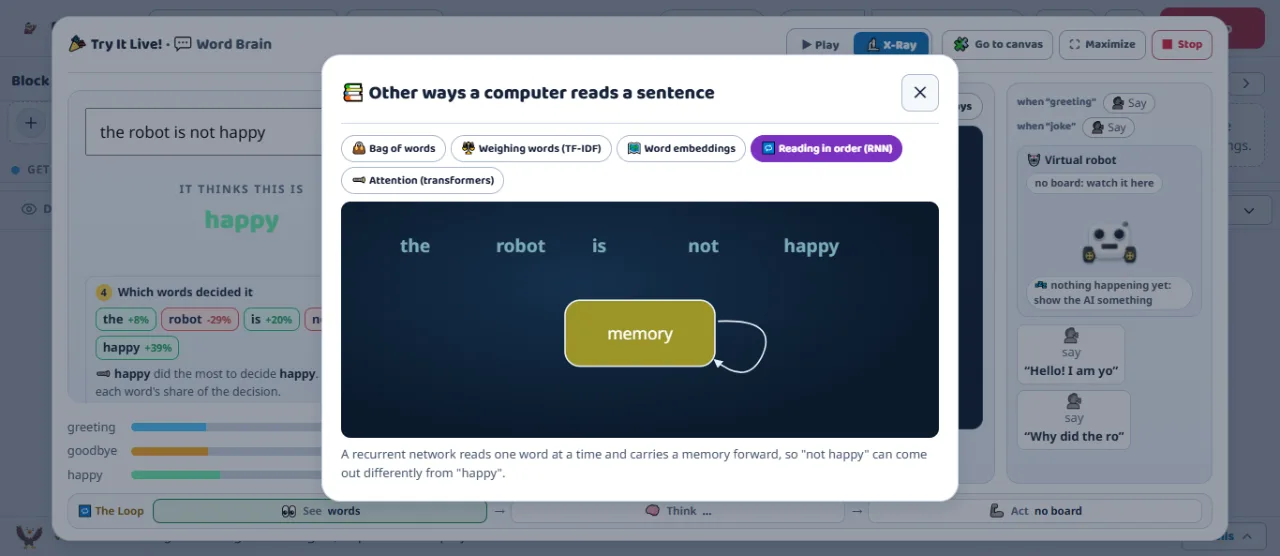
- It matches words, not meaning. “Not happy” and “happy” share a word, so it can confuse them.
- How it is tested
- By typing sentences it never saw, and reading which words decided the answer.
Ideas Creator is designed to teach
Words become numbers
Every language model starts by turning text into numbers. How it does that decides what it can notice.
Order can be lost
A bag of words ignores order, so “not happy” and “happy” look alike to it.
Writing is choosing likely words
A next-word model picks what usually came next, with no idea what the words mean.
Meaning from company
Words used in similar places end up close together on a map of meaning.
Fluent is not the same as true
Today’s chatbots are far bigger, but they still choose likely words, not checked facts.
Varied examples matter
Ten different sentences teach more than one sentence typed ten times.
Test with sentences it never saw
The same rule as every other journey: a model is judged on new examples.
Write new sentences
Type ways of saying each idea that were not in the examples, and see what it picks.
Read which words decided
The Word Brain shows each word’s push. A surprising push points to a missing example.
Add varied examples
Different words for the same idea, the way real people talk. Then test again.
Compare methods
“Other ways” shows how weighing words, word embeddings, reading in order and attention would change the answer.
Language AI learners already use
Next-word suggestions
Phone keyboards suggest the next word by what usually follows, the idea behind the Story Brain.
Sorting messages
Email and support systems sort messages into kinds, as the Word Brain sorts sentences into ideas.
Search that understands
Search finds pages with similar words, not only the same ones: the idea behind the Word Galaxy.
Where Creator sits on the path
Creator follows Explorer. A learner who knows what training and testing are will get the most from it.
- Before
Explorer Planned
Inside the network: layers, settings and evaluation.
- This journey
Creator Planned
undefined
- Next
Researcher Planned
Evidence, limits and responsible AI.
Available today, and planned
What a teacher can use now inside Maker, and what Creator will add.
Inside Maker today
- Word Brain
- Sorts sentences into ideas; example sets such as hello or a joke, happy or sad, and robot commands.
- Story Brain
- Writes one word at a time from the learner’s writing, and shows every choice.
- Word Galaxy
- A map of word meaning, word families, and the “king minus man plus woman” idea.
- Speaking and listening
- Say makes the laptop speak; a Voice block listens for a spoken keyword.
Planned
- Lessons built around language
- A path through the four parts: input, processing, output, evaluation.
- Chatbots with a character
- Giving a bot a personality and example conversations.
- Simple agents
- Chaining steps so a program can plan and act. Not built yet.
Planned, with no launch date yet
Leave your email and we will write once, when Creator opens. The language brains are in Maker now.
Get told when Creator opens
Start inside Maker now
Open the My Own Chatbot, Story Machine or Word Galaxy starter in Maker. Maker is open and free during early access.
Questions about Creator
When will Creator open?
Is this like ChatGPT?
Can learners build a chatbot now?
Will Creator include AI agents?
Where does the typed text go?
Words are data too.
Creator is planned. The language brains are inside Maker now.